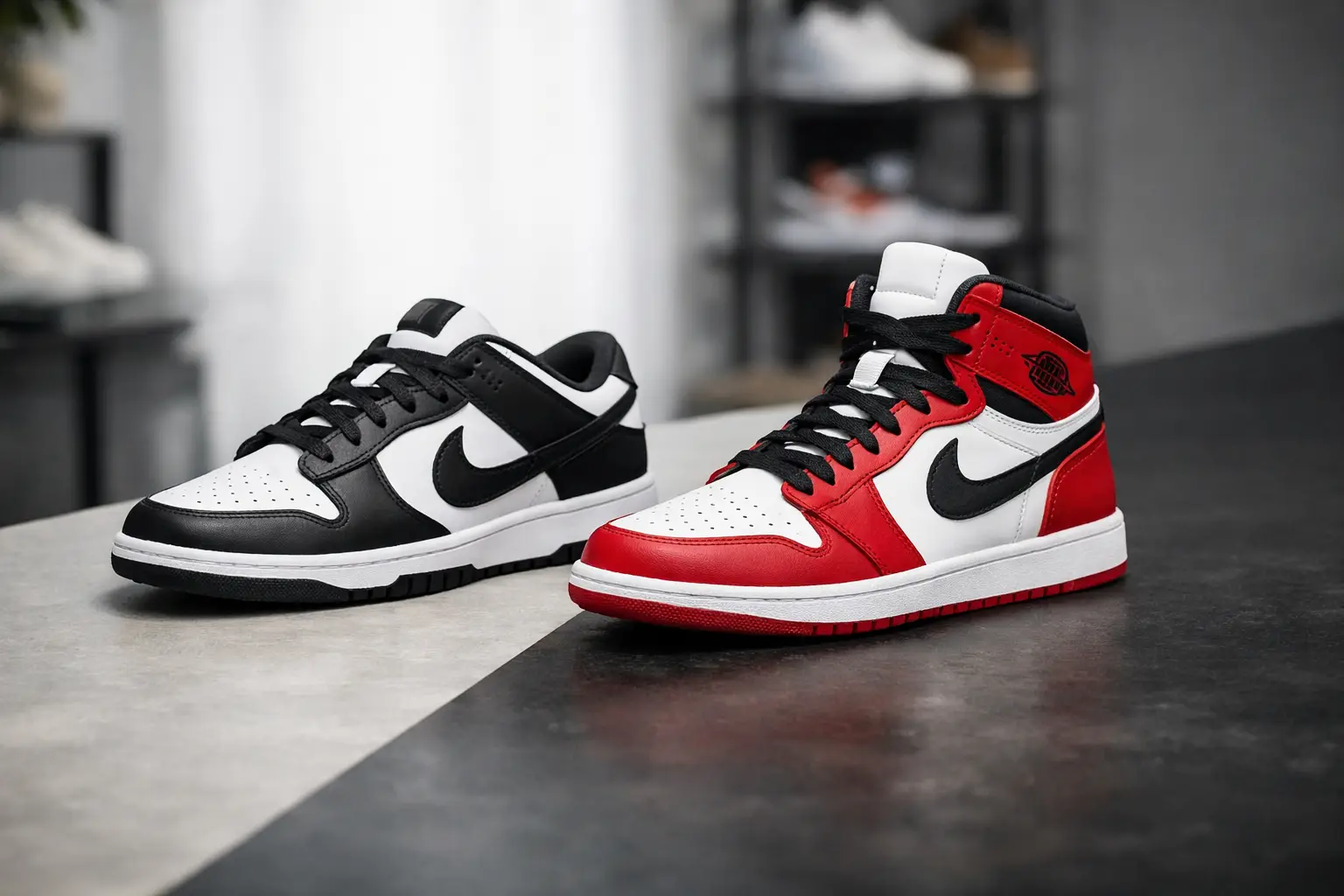
A Dunk Low and a Jordan 1 Low can look almost interchangeable from across the room. Both have Nike’s classic 1980s court-shoe shape, leather paneling, a low-cut collar, and endless colorways. Up close, though, dunk low vs jordan 1 is less about finding a winner and more about choosing the silhouette that makes sense for your rotation, wardrobe, and collecting habits.
The Dunk is cleaner, flatter, and rooted in college basketball before becoming a skate and streetwear staple. The Jordan 1 Low carries more visible basketball history, a slightly more layered build, and the unmistakable weight of the Air Jordan line. That difference shows up in how each pair fits, wears, and holds attention.
Dunk Low vs Jordan 1: The Design Difference
The Nike Dunk Low was introduced in 1985 through the Be True to Your School college program. Its design was built for the hardwood: straightforward leather panels, a perforated toe box, a padded collar, and team-color blocking that looked sharp on court. Decades later, the same simple formula is why it works with nearly everything off court.
The Air Jordan 1 Low arrived from the same era and shares a family resemblance with the original Jordan 1 High. But its details give it a different personality. The Jordan 1 Low typically has a more defined heel overlay, a Wings logo on the back, Jumpman branding on the tongue, and a slightly busier arrangement of panels. It feels less like a generic retro court shoe and more like a low-cut version of an icon.
The visual distinction is subtle but real. A Dunk Low’s side profile is flatter and more minimal, especially around the heel and collar. A Jordan 1 Low has a more sculpted upper and stronger brand signals. If you prefer sneakers that let the colorway do the talking, the Dunk often wins. If you want the shoe itself to carry the outfit, the Jordan 1 Low has more built-in presence.
Branding changes the mood
Dunks feature the familiar Nike wordmark at the heel and Nike branding on the tongue. That restraint is part of their appeal. Even a bold pair can feel easy to wear because the silhouette does not demand much attention.
Jordan 1 Lows come with the Wings logo, a major part of what collectors associate with the Jordan line. For some buyers, that logo is the point. It connects a low-top everyday sneaker to Michael Jordan’s signature legacy. For others, especially fans of stripped-back styling, it can make the shoe feel a little more branded than necessary.
Fit and Comfort: What to Expect on Foot
Neither model is a modern performance sneaker. Both use old-school construction and relatively firm foam midsoles, so expect lifestyle comfort rather than the softness of a current running shoe or a technical basketball model.
Most people can take their usual size in both. The Dunk Low generally feels a touch roomier through the forefoot, while the Jordan 1 Low can feel more structured around the midfoot and heel. That does not mean every release fits exactly alike. Materials matter. A pair made with stiff smooth leather can feel tighter at first than one made with softer tumbled leather, suede, or canvas.
If you have wide feet, start with your true size but expect a break-in period. Going up half a size may create extra length and heel movement, especially on a Jordan 1 Low. If you are between sizes or prefer thin socks, your regular size is usually the better call.
The biggest comfort factor is often the collar. Dunk Lows usually have more padding around the ankle, creating a plush, slightly skate-influenced feel. Jordan 1 Lows tend to feel more locked in, though their lower collar gives the ankle more freedom. For all-day walking, either works well once broken in, but neither should be chosen purely for cushioning.
Which One Is Easier to Style?
The Dunk Low is one of the easiest sneakers to build around because it is visually uncomplicated. White-and-gray, black-and-white, brown, navy, and green pairs work with jeans, cargos, shorts, relaxed trousers, and oversized sweats without feeling overthought. A louder colorway can become the focal point while the outfit stays simple.
Jordan 1 Lows lean slightly more intentional. They work well with straight-leg denim, clean workwear pants, varsity-inspired layers, and outfits that reference basketball or vintage sportswear. The shape also pairs naturally with shorts because the low collar keeps the shoe from visually crowding the ankle.
There are exceptions. A clean Jordan 1 Low in white, black, and red can be just as effortless as a Panda Dunk. Meanwhile, a special Dunk collaboration can be far harder to wear than a standard Jordan release. The better question is whether you want a versatile base sneaker or a pair with more story built into the design.
Colorways matter more than the model
A neutral Dunk Low is an everyday staple. A Jordan 1 Low in a classic Chicago-inspired palette reads instantly as a Jordan. A fuzzy, patterned, or collaboration-heavy Dunk may live in a completely different lane from both.
Before choosing, picture the pair with three outfits you already wear. If it only works with a hypothetical new wardrobe, it may become a shelf piece. That is not necessarily a bad thing for a collector, but it is worth knowing before you buy.
Culture, Collaborations, and Collectibility
The Dunk’s modern reputation was shaped by Nike SB, skate shops, limited releases, and collaborations that made the shoe a canvas for niche references. From skateboarding to music to design culture, the Dunk has absorbed influences from far beyond basketball. That flexibility is why a Dunk can feel understated one week and like the center of a release calendar the next.
Jordan 1 Lows live within a larger, more recognizable universe. Their cultural power comes from the Air Jordan 1, arguably the most influential sneaker silhouette ever made. Highs often receive the headline treatment, but lows have developed their own following through original-style color blocking, women’s exclusives, seasonal releases, and collaborations such as Travis Scott’s reverse-Swoosh designs.
For resale and collecting, scarcity and storytelling matter more than the name on the box. A general-release Dunk Low may be easy to find at retail or near it, while a limited SB Dunk can command serious attention. The same goes for Jordan 1 Lows: many regular colorways remain accessible, while a notable collaboration can become a major collectible.
That makes both models good entry points for a collection. You can buy a wearable pair without treating every purchase like an investment, then reserve the bigger budget for a release you genuinely connect with. Trend cycles move quickly. Personal taste tends to last longer.
When to Choose a Dunk Low
Choose the Dunk Low if you want a cleaner, more relaxed sneaker that can disappear into almost any outfit. It is especially strong for people building a rotation around neutral colorways, casual fits, skate-inspired looks, or statement color blocking. The padded collar and simple panel layout give it an easygoing feel that is hard to beat.
It is also the stronger choice if you are drawn to Nike SB culture. SB Dunks often have a chunkier padded tongue, upgraded materials, and a different energy from standard Dunks. Just remember that an SB Dunk does not fit exactly like a regular Dunk Low, so sizing preferences can change.
When to Choose a Jordan 1 Low
Choose the Jordan 1 Low if the Air Jordan story matters to you. It delivers a recognizable heritage look without the taller collar of the Jordan 1 High, making it easier to wear daily in warmer weather or with cropped and straight-leg pants.
It is a smart pick for someone who wants a little more detail in a familiar silhouette. The Wings logo, layered upper, and classic Jordan color blocking make even simple releases feel connected to a larger legacy. For collectors, certain collaborations and original-color-inspired pairs can also carry more lasting significance than a random seasonal drop.
The Better Pair Is the One You Will Wear
Dunk Low vs Jordan 1 is not a battle between a good shoe and a bad one. The Dunk Low is the cleaner, more casual option with deep roots in skate and streetwear culture. The Jordan 1 Low is the more heritage-driven option, carrying the visual language of the Air Jordan line in a lighter everyday package.
If you are buying your first pair, start with the colorway that fits your closet and the silhouette that feels right on foot. The pair you reach for three times a week will matter more than the one everyone was chasing last season.