The reverse Swoosh did more than give Nike a recognizable design cue. It turned a collaboration into a visual shorthand for a specific era of sneaker culture: earthy palettes, worn-in materials, high-pressure drops, and pairs that move just as naturally with vintage denim as they do into a display case. Travis Scott sneaker collaborations matter because they changed the standard for what an artist-designed shoe could look like, and what it could mean to own one.
For collectors, the appeal is not simply that the shoes are hard to get. Scott's best releases connect Cactus Jack's dusty, Houston-rooted aesthetic with silhouettes that already carry serious basketball, skate, and running heritage. The result is a catalog with real range. Some pairs are loud cultural artifacts; others are surprisingly wearable daily sneakers. Knowing the difference is what separates buying a logo from building a focused collection.
Why Travis Scott Sneaker Collaborations Changed the Formula
Before the reverse Swoosh became a fixture of modern hype, celebrity footwear often followed a predictable pattern: take a familiar model, add a signature color, and attach a famous name. Scott's Nike and Jordan work pushed further. Panels were repositioned, pockets were added, materials became intentionally distressed, and color stories favored dark mocha, olive, sail, and muted earth tones over easy team colors.
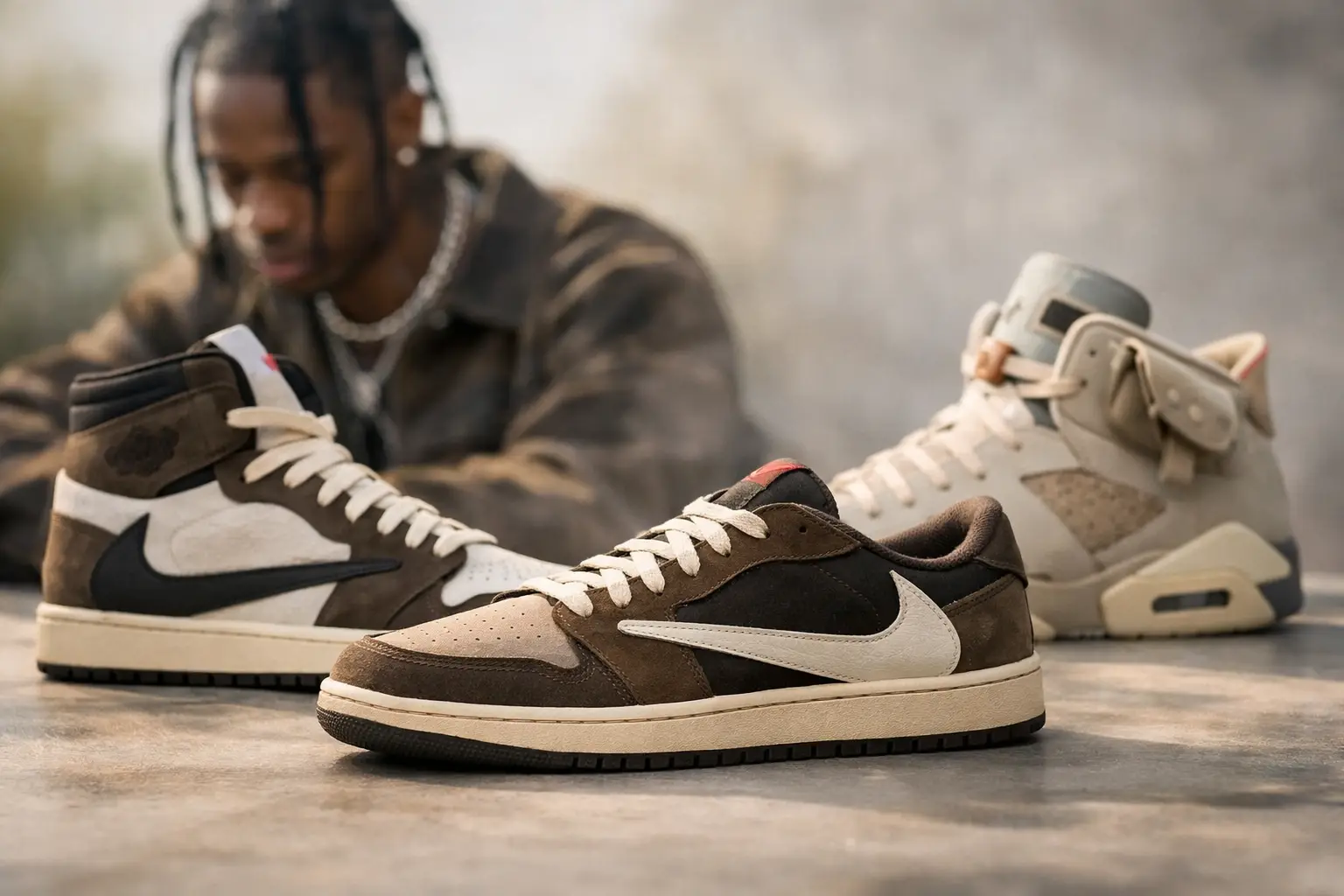
The Air Jordan 1 High OG from 2019 remains the clearest example. Its backward lateral Swoosh was instantly polarizing, but it also made the shoe identifiable from across a room. Hidden stash pockets and soft brown suede added details that rewarded a closer look. More importantly, it made a classic Jordan feel newly authored instead of merely recolored.
That approach landed at the right moment. Sneaker fans were already moving toward vintage-inspired styling, looser denim, workwear, and washed graphic tees. Scott's shoes fit that shift without looking like costume pieces. A Travis Scott Jordan could be the rare major release that looked better after a few wears, not worse.
The Key Releases, and What Sets Them Apart
The catalog began with Nike Air Force 1 projects, including the 2017 AF100 pair designed with removable Swoosh patches. It was experimental and playful, but the early Jordan releases established the language collectors now recognize. The 2018 Air Jordan 4 "Cactus Jack" brought suede uppers and a bright University Blue colorway tied to Scott's then-signature look. The purple version became one of sneaker culture's most famous unreleased samples, proving that even what does not hit retail can shape demand.
The 2019 Air Jordan 1 High is still the headline pair for many people. It carries the strongest crossover appeal between sneaker collectors, fashion audiences, and Jordan purists. The high-top shape gives it presence, while the brown-and-black palette makes it easier to style than a typical statement release. Its low-top counterpart extended that formula with a more casual profile, and later low colorways showed how much room the concept had to evolve.
Then came the Nike SB Dunk Low in 2020, arguably the most detail-heavy Travis Scott release. Its plaid and paisley upper was built around tear-away layers, so wearing the pair could change its appearance over time. For some collectors, that feature is the whole point. For others, it creates a trade-off: cutting into a scarce pair may feel creatively right, but it can reduce its appeal to buyers who want an untouched example.
The Air Jordan 6 introduced cargo-pocket detailing, while the 2021 Fragment Design Air Jordan 1 High and Low releases brought Hiroshi Fujiwara's blue, white, and black palette into the Cactus Jack universe. Those Fragment pairs remain especially significant because they joined three powerful names without becoming visually cluttered. They feel more graphic and polished than the original brown Jordan 1s, which makes them a strong choice for collectors who prefer crisp color blocking.
Scott's Air Max 1 and Air Trainer 1 releases in 2022 were more divisive. Their outdoors-inspired construction, mesh-heavy uppers, and rugged details broke from the clean simplicity of his Jordan 1s. That is exactly why they deserve a second look. They are less obvious status symbols and more design-driven shoes, particularly for people who actually want to wear their collection.
More recent models such as the Jordan Jumpman Jack and the Zoom Field Jaxx showed another important shift: Scott was no longer only remixing beloved Nike archives. He was helping introduce newer footwear identities. That comes with risk. A first-signature model does not have the instant familiarity of an Air Jordan 1 or SB Dunk. But it also gives collectors a chance to own a piece of a developing design story rather than another variation on a proven classic.
How to Choose the Right Travis Scott Pair
Start with the silhouette, not the resale conversation. The most celebrated pair is not automatically the best pair for your rotation. If you wear slim or straight denim and want a sneaker that works across seasons, an Air Jordan 1 Low is usually easier to live with than a bulky trainer. If you favor carpenter pants, wide-leg jeans, or technical outerwear, the Air Max 1 and Field Jaxx make more visual sense.
Color also matters more than hype cycles suggest. Brown, black, sail, and olive Travis Scott pairs work because they behave like neutrals while still carrying unusual details. University Blue Jordan 4s and Fragment Jordan 1s make a stronger statement, but they demand more intentional outfits. Neither direction is better. It depends on whether you want your sneakers to anchor the look or finish it.
Condition should match your purpose. A deadstock pair may suit a serious archive or a milestone purchase. A clean, lightly worn pair can be the smarter choice if you want to enjoy the shoe without treating every step as a financial decision. With older suede-heavy releases, inspect the nap, midsole paint, heel wear, box condition, spare laces, and any special packaging. Those details can affect both the experience of owning the pair and its long-term desirability.
Sizing is model-specific. Air Jordan 1 Highs and Lows generally work true to size for most wearers, though people with wider feet may prefer going up half a size. SB Dunks can feel more padded and snug through the forefoot. Air Max 1s are often comfortable true to size, but their fit can vary depending on foot shape and the heavier layered upper. When possible, prioritize the fit of the underlying Nike model over assumptions based on the collaborator's name.
The Cultural Value Is Bigger Than a Reverse Swoosh
The most lasting contribution of Travis Scott's footwear work is the way it made collaboration feel like world-building. A drop could include apparel, music-era references, packaging, campaign imagery, and design details that fed one coherent point of view. That gave fans more to engage with than a release date and a product shot.
It also changed what brands expect from artist partnerships. Today, a collaboration is often judged on whether it brings a distinct visual language to the sneaker, not just attention. Scott set a high bar for recognizable codes: backward branding, muted palettes, utility accents, and materials that feel better with age. Plenty of releases have borrowed parts of that playbook. Very few have made it feel as connected to the artist.
That visibility creates one downside: the catalog is easy to chase for the wrong reasons. Not every Travis Scott release needs to be treated as a guaranteed investment, and short-term prices can react sharply to restocks, rumors, broader market shifts, and changing tastes. Cultural importance and market value often overlap, but they are not the same thing.
The best Travis Scott sneaker collaborations are still the pairs that make you pause before you check the price: the brown Jordan 1 that looks more personal the longer you study it, the SB Dunk that changes when you wear it, or the unusual trainer that suddenly works with an outfit no standard retro could complete. Choose the one you will remember putting on, not just the one everyone else remembers selling out.